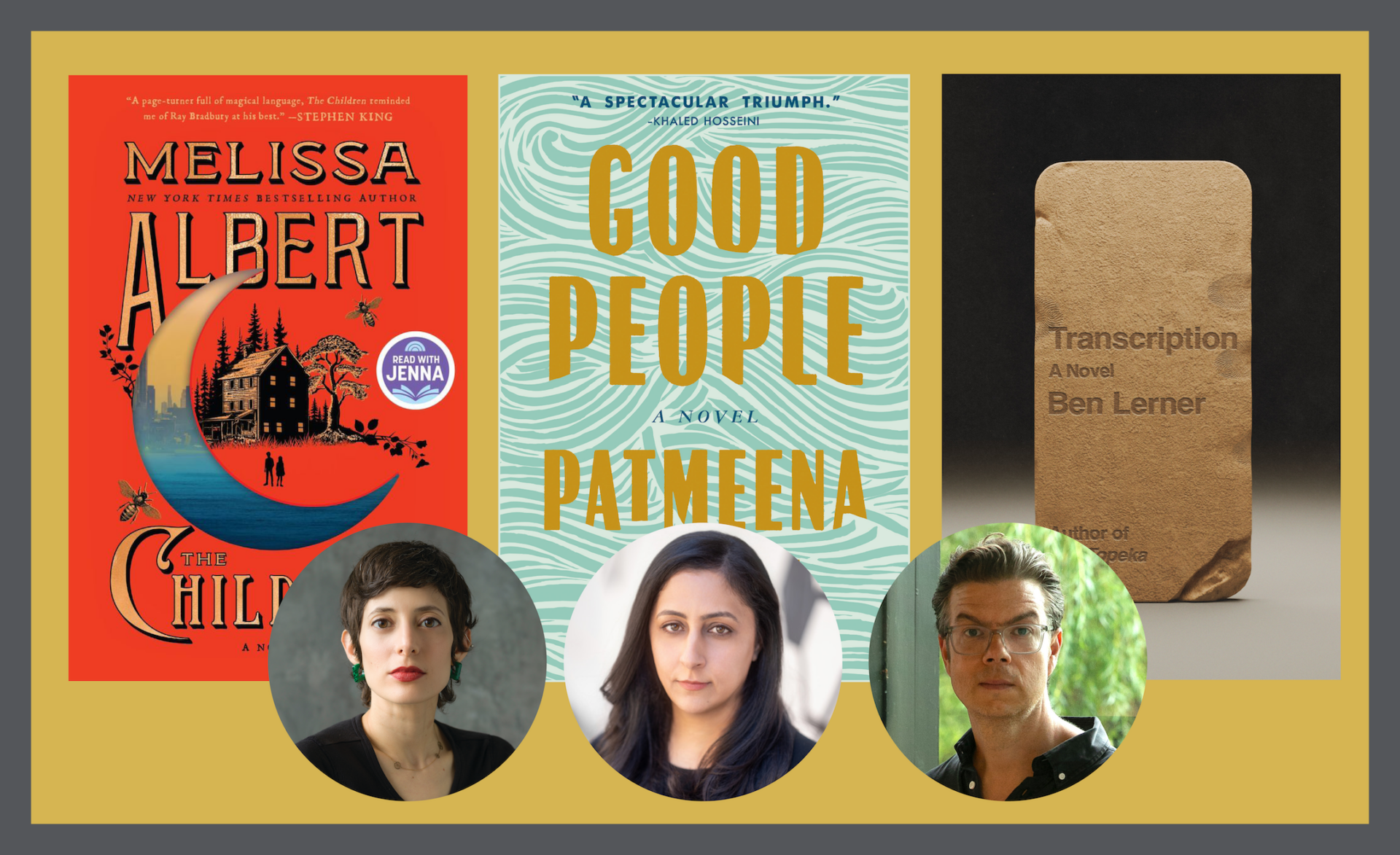
The Westport Prize for Literature is excited to announce its 2026 finalists: Transcription by Ben Lerner, The Children by Melissa Albert, and Good People by Patmeena Sabit. The annual award honors original, timeless works of long-form fiction published in the U.S., with the winner selected by an independent jury and administered by Westport resident volunteers.
This year’s $10,000 prize marks its fourth year. The inaugural winner was Zadie Smith for The Fraud (2023), which was named one of the best books of the year by The New York Times, The Washington Post, The New Yorker, and The Independent. Alejandro Puyana received the 2024 prize for his acclaimed debut novel Freedom is a Feast, and Olufunke Grace Bankole received the 2025 prize for her debut novel The Edge of Water.
"Every year I'm struck by the caliber of submissions this prize attracts," said Candice Savin, chair of the Westport Prize for Literature steering committee. "This year's finalists are proof that the prize continues to draw extraordinary literary talent, and I know this November's conversation at The Westport Library will be a memorable one."
The jurors for 2026 are playwright and author Tommy Greenwald, book blogger and aggregator Suzanne Leopold, publishing industry veteran Erica Melnichok, The Lifeboat author Charlotte Rogan, and freelance editor Stephanie Klose.
The narrator of Ben Lerner's new novel has traveled to Providence, Rhode Island, where he is to conduct what will be the final published interview with Thomas, his 90-year-old mentor and the father of his college friend Max. Thomas is a giant in the arts who seems to hail "from the future and the past simultaneously" and who "reenchants the air" when he speaks. But the narrator drops his smartphone in the hotel sink. He arrives at Thomas's house with no recording device, a fact he is mysteriously unable to confess.
What unfolds from this dreamlike circumstance is the unforgettable story of the triangle formed by Thomas, Max, and the narrator, and an exploration of fathers and sons, male friendship and rivalry, and the challenges of parenting in a burning world. One of the first great novels about the early days of COVID, it is also a brilliant meditation on those technologies that enrich or impoverish our connection to one another, that store or obliterate memory. Full of startling insight, but written with the intensity of a séance, Lerner shows us how the air is full of messages, full of ghosts. Ultimately Transcription demonstrates what only a work of fiction can record.
"Transcription is my attempt to think about what literature can capture that our phones and other recording devices miss. It is, among many other things, about the power of the book as a handheld device," Lerner said.
Lerner is the author of eight previous books of poetry and prose, as well as several collaborations with visual artists. A recipient of Fulbright, MacArthur, and Guggenheim fellowships, he has been a finalist for the National Book Award for Poetry and the Pulitzer Prize for Fiction, among other honors. He is a Distinguished Professor of English at Brooklyn College.
“Beautiful and resonant ... Lerner’s lyrical narrative brims with insights into how memories take and change shape, the nature of father figures, and the ways an artist’s influence echoes through time. It’s a knockout.” — Publishers Weekly
Guinevere Sharpe has two childhoods. In one, she and her brother, Ennis, live in the wooded shadow of their family's isolated Vermont farmhouse; in the other, the pages of their mother's world-famous Ninth City books, where their magical adventures have made them household names. In reality, Guinevere's childhood isn't the enchanted idyll her mother's readers imagine: she and Ennis are growing up near-feral, unwashed and underfed, escaping each day to the wild woods they've made their playland. As Edith Sharpe's books explode into epic popularity, the threats of a rural childhood give way to the escalating perils of fame — until the night it all goes up in flames, leaving Edith's series unfinished and her children the sole survivors.
Now an adult coasting on her mother's name, Guinevere is mid-promotion for a ghostwritten memoir when her estranged brother, an artist who has until now spurned his family's legacy, announces an upcoming installation titled, simply, Mother. As rumors swirl around a death connected to his last show, unsettling recollections from Guinevere's childhood begin to surface. Her public facade starts to crack, forcing her to confront the questions she's spent the last 20 years running from: What really happened the night of the fire? And what dark history lies behind their mother's fantasy world?
“The Children is wise to the mythic weight childhood memories gather over time, and the way our most beloved stories grow up with us,” Albert said. “It's for anyone who's ever revisited an old favorite and found its pages cast in a darker light, the line separating magic from reality blurring as we discover the books that once comforted us carry shadows of their own.”
Albert is the New York Times and indie bestselling author of The Bad Ones, Our Crooked Hearts, and the Hazel Wood series. Her work has been translated into more than 20 languages and included in the New York Times list of Notable Children's Books. The Children is her first adult novel.
“An extraordinary book. It’s a page-turner, full of mystery, but that’s the least of it. The language is dusted with magic. The Children reminded me of Ray Bradbury at his best.” — Stephen King
Zorah Sharaf could do no wrong. Zorah Sharaf brought shame upon her family. What's the truth? Depends on who you ask.
The Sharaf family is the picture of success. Prosperous, rich, happy. They came to this country as refugees with nothing more than the clothes on their backs. And now, after years of hard work, they live in the most exclusive neighborhood, their growing family attending the most prestigious schools. Zorah, the eldest daughter, is the apple of her father's eye.
When an unthinkable tragedy strikes, everyone is left reeling and the family is thrust into the court of public opinion. There is talk that behind closed doors the Sharafs' happy household was anything but. Did the Sharaf family achieve the American dream? Or was the image of the model immigrant family just a façade?
Like a literary game of ping-pong, Good People compels the reader to reconsider what might have happened even on the previous page. Told through a kaleidoscope of perspectives, it is a riveting, provocative, and haunting story of family — sisters, brothers, mothers, fathers, and the communities that claim us as family in difficult times.
"I wrote the book as a way of exploring, in a nuanced way, the dynamics within a community that could give rise to such a crime, while also exploring the sensationalist media coverage and larger Islamophobic discourse that a discussion of such crimes give rise to," Sabit said. "The novel is also informed by the Afghan experience of exile from a country where for over 40 years the only constant has been war and bloodshed, and by what it means to be Muslim in the West in a post-9/11 world."
Sabit was born in Kabul a few years after the Soviet invasion of Afghanistan. When she was a month old, her family fled the conflict and became refugees in Pakistan, joining the millions of other Afghans who had sought refuge there. They later moved to the United States, where she grew up in Virginia. She currently lives in Toronto.
“Sabit’s first novel masterfully dissects the glittering facade of the American Dream ... This all unfolds like a binge-worthy true-crime podcast ... It’s voyeuristic and intimate, pulling readers into the fray as if huddled around a kitchen table, trading secrets over chai. At once heartbreaking and hypnotic, Sabit's is a novel that demands to be devoured.” —Booklist